

Khol – the traditional Sankari Percussion instrument of Assam
by Manoj Kumar Das*
Classification of Indian Musical Instruments-
Music (Sangeet) means especially singing accompanied by instrumental music and dancing harmoniously. Music (Sangeet) is also known as “Touryatrik” as it is the union of song, dance and instrumental music. Hence, the musical instruments are part and parcel of music.
Depending on the method of construction and playing, the Indian musical instruments which are countless in number, have been classified mainly into four groups. In the “Natya Shastra” of Bharatmuni and also in the “Sangeet Ratnakar” of Sharangadeva, mention has been made about these four groups of musical instruments. These four groups are Tat Badya, Ghana Badya, Sushir Badya and Awanaddha Badya.
Classification of Indian Musical Instruments:
- Tat Badya (Stringed instruments)
The instruments in which the musical sound is produced by striking the strings of the instrument are known as the Tat Badya, i.e., these are stringed instruments. For example: Sitar, Violin, Tanpura, Sarengi, Ektara etc. Dotara, the indigenous instrument of Assam which is part and parcel of folk songs of Kamrup and Goalpara and also of Jikir songs, is a Tat Badya.
- Ghana Badya
These musical instruments are either made of bamboo, timber, or metal that is brass or bell-metal. The musical sound is produced by striking on these instruments. This type of instruments is scarcely used in classical music. Generally, these instruments are considered useful in maintaining or controlling harmony in singing or dancing. For example – Cymbals, Bamboo clapper (Tala) used in the Sattriya culture of Assam falls under this category.
- Sushir Badya
Instruments which are played on by blowing air with mouth or by some other means are known as Sushir Badya. For example – Flute, Sehnai, and Pepa, which is commonly played in Bihugeet of Assam, fall under this category of musical instrument.
- Awanaddha Badya
The word “Awanaddha” literally means bound on, tied, fastened or covered. The musical instruments of which the open end or ends of the main body of the instrument (also called the mouth) are firmly covered with animal skin and sound is produced by striking on these covered ends either with fingers or with the help of sticks are known as the “Awanaddha Badya”. The body of instrument may be made of either earth, wood or metal. For example – Tabla, Pakhawaj, Mridangam, Dholak, Khol etc. Instruments of this category play the main role in maintaining harmony in most types of music, both classical and folk music.
Khol: Its Creation, Shape, Size and Various Parts and Its Use
Khol, the unique musical instrument of Assam, belongs to the Awanaddha group of Indian musical instruments. Mahapurusha Srimanta Sankaradeva innovated this special kind of drum. Earlier, Mridanga was the popular drum in Assam.
Some hagiographers, namely, Ramcharan Thakur is his “Guru-Charit” (in verse) and another hagiography “Katha-Guru-Charit” (in prose) give details how Srimanta Sankaradeva created and introduced Khol on the occasion of performance of his maiden play “China-Yatra.” This play was enacted in 1468 CE.
Srimanta Sankaradeva prepared the model of Khol with a piece of wood. One Boloram Atai suggested the diametrical measures of “Baya” (left end) and “Daina” (right end) as thirteen angul and nine angul respectively. Srimanta Sankardev got it completed by engaging some efficient potters from Kapilimukh to construct the main body of Khol using earth, having conformity to the wooden model and cobblers for completing the instrument using animal hide.
Again, in the “Katha-Guru-Charita”, we get this description about the construction of Khol – “Guru Kapili mukhar Kolang Kakhar Kumarat Khol gorhale, jokh di, daina sat angul, beya ter angul, hal, chale.”
In some hagiographies some differences are noticed regarding the diametrical size of the diana (right end). According to some, it is nine angul, and some others mention if as only seven angul. But the size of the ‘baya’ (left end) of thirteen angul is commonly accepted.
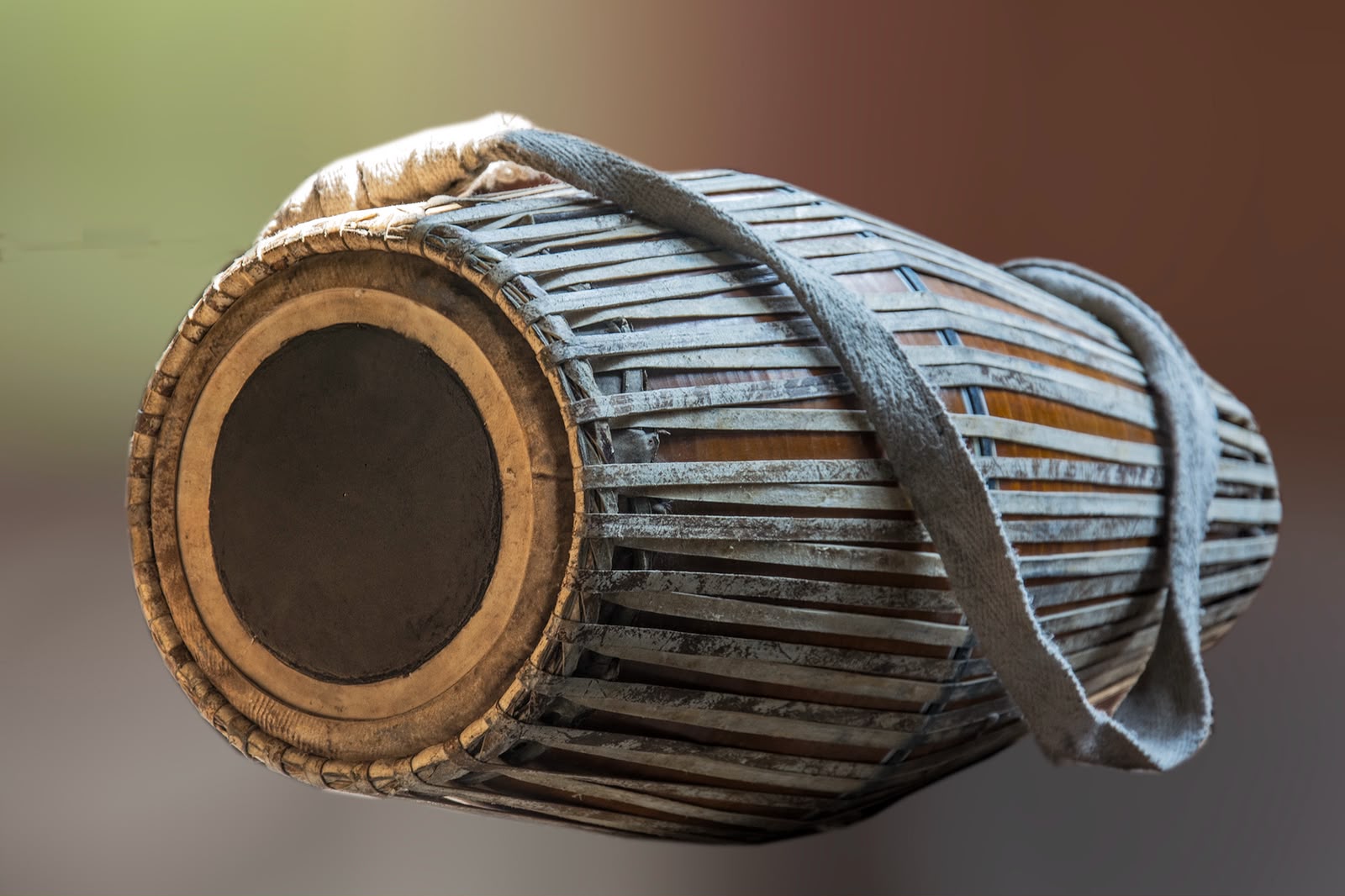
Various Parts of Khol
In the past, the main body of ‘Khol’ was made of earth, but now a days, it is generally made of wood preferably of jack-fruit. Generally, skin of cow is used to make it complete for using as a musical instrument.
The two main parts of Khol are the open ends of the body, – one bigger end (left side) known as baya and the other smaller end (right side) known is daina.
Various parts of Khol are Dima or Khola, Dayan or Daina, Bayan or Baya, Tali (Daina Tali and Bayan Tali), Maluwa or Bandhani, Dona, Katani tali, Petidol, Puli, Dol, Tikani, and Ghun.
(1) Dima or Khola-
The main part of the instrument is known as the Dima or Khola. It is generally made of wood or earth. The shape of the Dima is oval like black Myorobalan fruit (A – Shilikha, B – Haritaki) and follow inside having one bigger and one smaller end. It is seen that the length of the Dima varies from 18 inches to 26 inches according to the choice of the Bayan (the player).
(2) Dayan or Daina-
The right smaller end generally known as the small mukh of the Dima, is known as the Dayan or Daina. The diametrical measure of the daina varies according to the length (i.e. size) of the Dima.
(3) Bayan or Baya-
The left bigger end, also known as the big mukha, is known as the Bayan or Baya. The diametrical measure of Bayan also varies according to the size of the Dima.
(4) Tali-
The main skin (animal skin) that covers both the open ends of the main body (i.e. Dima) of Khola, are known as the Tali. They are known as the daina tali or dayan tali and bayan or baya tali.
- Daina Tali or Dayan Tali: The tali that covers the smaller right end of the main body (i.e. dima) of the khola is called the Daina Tali. The sound produced by this tali is sharp than the baya tali.
- Bayan Tali or Baya Tali: The tali that covers the bigger left end of the main body (i.e. Dima) of Khola, is termed as the Bayan Tali or the Baya Tali. The sound produced by this tali is soft than the sound produced by the Diana Tali.
(5) Maluwa or Bandhani-
The coils made of fine straps of leather round the circumference of both ends of the dima, i.e. the baya and diana of Khola, are known as the Bandhani or Maluwa.
(6) Dona
The straps of leather those are used length wise over the main body of the khol in order to fix both the talies (i.e. Daina and baya tali) with the main body are known as Dona. These dons are also used for tuning the instrument either loosening or tightening these straps.
(7) Katani tali
The thick leather cover attached just beside the maluwa or bandhani of both ends are known Katani tali. Half of the Katanitali remains over the main talies of both ends.
(8) Petidol
Some coloured fine straps of leather or strings that are wound round the middle of the main body, for beautification of the instrument is known as Petidol.
(9) Puli
In the maluwas of both diana and bayan, some small bores are provided so that the baya and the daina tali, can be fastened tightly on the dima by passing dons through these holes or openings. These are known as puli. Generally, the number of puli is 32.
(10) Dol
Generally, a wide strap of leather or cloth is used to hang the Khol on shoulder of the player comfortably while playing the instrument. This strap is called the Dol.
(11) Tikani
The two rings of fine straps of leather provided at the moluwa or bandhani at the daya and baya ends of Khol to fasten the petidol, are known as Tikani. The Bayan (player) fastens the petidol to these rings while playing.
(12) Ghun
The circular black colour central parts of both the talies are known as Ghun. A mixture of pulverised iron and charcoal with cooked rice is prepared and applied carefully on the central parts of the talies to form a circular cover. The quality of sound of the Khol mainly depends on the quality and craftsmanship in preparing these Ghun.
Definition of Barna, Bani, Bols-
The word “Barna” literally means letter (Aksara). If we are to learn or write in a language, we must be familiar firstly with the letters of that language, and likewise, we require to be familiar firstly with the ‘barna’s or letters of Khol to play on it. As a letter or combination of letters expressing a meaning is called ‘word’, likewise, the melodious sounds produced by applying strokes on both talies of khol are known as ‘Barna’, ‘Bani’ or ‘Bol’ of Khol.
There are mainly five numbers of Barna, Bani or bols.
(a) On Daina – Three numbers, e.g.
Tong or Nong
Ta or Na
Tak or Nak
(b) On Baya – Two numbers, e.g.
Dhin
Khit
In addition to these five numbers of principal ‘bol’s, we get some other ‘bol’s which are the combinations of the principal ‘bols’.
The ‘bol’s of khol may generally be classified into three groups, e.g.
(a) Ekaka Unique ‘bol’s of Daina or Daya
(b) Ekaka or Unique ‘bol’s of Baya
(c) Combined ‘bol’s.
(a) Ekaka (Unique) ‘bol’s of Daya
The musical sounds produced by strokes on the daya are termed as the Ekaka (Unique) ‘bol’s of daya, e.g. – Tang, Ta or Na, Tak or Nak, Ti or Ni etc.
(b) Ekaka (Unique) ‘bol’s of Bayan
The musical sounds produced by strokes on the baya are termed as the Ekaka (unique) ‘bol’s of baya, e.g. – Dhin, Khit, Dhi, Khi etc.
(c) Yugma (Combined) ‘bol’s
The musical sounds produced by strokes applied simultaneously with both hands on the baya and daya of khol are termed as the Yugma (combined) bols. E.g. – Dhei, Thei, Dhen, Then etc.
- Methods of Playing the Ekaka (Unique) ‘bol’s of Daya
(1) Tong or Nong
When a strong and open “tokar” stroke is applied at central part of ghun of daya tali with the front part of the forefinger of right hand after spreading out all the fingers, the ‘bol’ Tong or Nong comes out.
(2) Ta or Na
When a stroke “Khola Chapar” is applied on the ghun of daya holding together the fore, middle, ringfinger and little finger of right hand, the ‘bol’ Ta or Na comes out.
(3) Tak or Nak
When a stroke “tepa chapar” is applied hard on the middle of ghun of daya holding together the middle, ring and little finger of right hand, the ‘bol’ Tak or Nak comes out.
(4) Tat or Nat
When a ‘tepa chapar’ is applied slightly on the lower part of ghum of daya holding together the middle and ring finger of right hand, the ‘bol’ Tat or Nat comes out.
- Methods of Playing Ekaka (Unique) ‘bol’s of Baya
(1) Dhin
This musical sound is produced by applying a sharp stroke (sharp khola chapar) on the upper part of ghun of baya, using upto the middle part of the fore, the middle, the ring and the little finger of left hand held together.
(2) Khit
The pressed stroke applied on the mid-part of ghun of baya using the front parts (slightly bent) of the fore, the middle, the ring and the little finger, produces this ‘bol’.
(3) Dhi
The open stroke, khola chapar, applied on the baya, using middle part of the fore, the middle, the ring and the little finger of left hand, produces the ‘bol’ – Dhi.
(4) Ki
When a soft stroke (Komal Khola Chapar) with the tips of fingers, is applied on the upper part of ghun of baya with foremost parts of the fore, middle, ring, and little finger held together and slightly bent also lifting the hand just after the stroke, this ‘bol’ comes out.
(5) Khi
This bol is produced by applying stroke as in the case of Ki with a difference that the stroke is applied on the mid-part of ghun with the foremost parts of the fingers.
III. Methods of Playing Yugma (Combined) Bols
(1) Dhei
This bol is produced by playing Tan or daya and dhin or baya simultaneously,
e.g.Tong + Dhin = Dhei.
(2) Thei
Produced by playing Tan or daya and Khit on baya simultaneously.
E.g. Tong + Khit = Thei.
(3) Dhe
When Ta or Na of daya and Dhi of baya are played simultaneously, this bol comes out.
(4) Dhen
Produced by playing Na of daya and Dhin of baya maintaining a minute interval between the ‘bols’.
(5) Then
Produced by playing Na of daya and Khit of baya with minute interval.
(6) Khur
Produced by playing Trat of daya and Khi of baya together.
(7) Gur
Produced by playing Dhi of baya with Trat of daya simultaneously.
(8) Khurun
This ‘bol’ is produced by playing Khit of baya at first followed Tran of daya maintaining a minute interval in between.Khit + Tran = Khurun.
(9) Khurak or Khurat
Produced by playing Khit of baya at first followed by Trat of daya maintaining a minute interval in between the two ‘bol’s.
Khit + Trat = Khurak or Khurat.
(10) Rid
To produce this ‘bol’, firstly the Dit of baya is played and then Trat of daya played with a minute time interval in between.
TALS & BAJANAS OF KHOL
There is a considerable number of Tals & Bajanas of Khol prevalent in various satras throughout Assam.
Without going into details of each and every ‘tal’, it is intended to give an introduction in short, to different parts or components of ‘tals’ as a whole, such as Gaman (or the main tal), chok, Ghat, Dhemali etc.
1\. Gaman or Mul Bajana
To display a ‘Tal’ in khol, the performer plays a composite ‘bol’ with proper maintenance of Tali, Khali, Matra, Bibhag etc. of that ‘Tal’, & this particular part of a ‘Tal’ is known as Gaman or Mul (main) bajana of that ‘Tal’. This part of the ‘Tal’ is played repeatedly.
2\. Choka
Some ‘bols’ composed elegantly in expanded form are played in ‘druta Laya’ at the end of mul bajana (main Tal). This part is known as ‘Choka’.
3\. Ghat or Ghata
When the ‘bol’s of a ‘tal’ are played in expended and stylish manner, it is known as ‘Ghat’ or ‘Ghata’. The ghat or ghata of each ‘tal’ are different.It is seen that a ‘tal’ generally has two or three numbers of ‘up (sub) ghat’.
Practically, there are different types of ‘ghata’, such as, Gurughat, Layaughat, Thawanighat, Maalitar Ghat, Joronghat,Choraghat, Bhanganighat etc.
4\. Guru Ghat or Guru Ghata
The Guru Ghat or Guru Ghata is a very large and auspicious tal. It is generally performed in front of the “Guru Asana”, the altar, placed in their worshipping hall by the Vaisnavas of Assam, to call this Guru, the great religious preceptor Mahapurush Srimanta Sankaradeva and his other disciples to their minds and hence, this tal is known as the Guru Ghat or Guru Ghata. It is the chief and the longest ghat among all the other ghats. It is a custom in Barpeta Satra, the most important Vaisnavite religious institutions of Assam, that the guru ghat is generally performed in the evening as “Sewar Kirtan”, in the form of Prasanga, (the praise and prayer daily offered to Vishnu by the devotees) and on the occasion of birth and death anniversaries of the Guru and other important disciples after the regular prasanga.The Guru ghat is a fine and composition comprising a large number of neatly arranged melodious metres.Some parts of Guru Ghat are found to be included in some other types of tals called the “Dhemali’s”.
Generally, we get in Guru Ghat a combination of four numbers of special ghats or ghatas e.g. (i) Lawanu ghata, (ii) Ghat related to Raga, (iii) Sanchar ghat or Raga Sanchar ghat and (iv) Samarani (concluding) ghat.
5\. Dhemali
The meaning of the word Dhemali is frolicking, but Dhemali is a kind of playing of Khol, which is very interesting. Dhemali is usually played before the commencement of ‘Bhaona’ (a kind of ply written by Mahapurush Srimanta Sankaradeva and Madhavadeva.
Different kind of Dhemalis are – Bor Dhemali, Saru Dhemali, Maju Dhemali, Ghokha Dhemali, Nat Dhemali, Chalan Dhemali and Guru Mridanga Dhemali. Bardhemali is played at Barpeta Satra in the Kirtan (celebration of annual death anniversary of Mahapurush etc.), Doul festival, Domahi. Sarudhemali on the otherhand is played on Magh Bihu in the front-yard of Math (residence of Mahapurush of Madhavdeva at Barpeta Kirtanghar and Nat Dhemali in the Janmastami of Lord Srikrishna, Chalan Dhemali at Kirtan Mahatsova, Guru Mridanga Dhemali at Patbausi Satra by the Gayan Bayans from Barpeta Satra during the Kirtan Mahatsova of Srimanta Sankardeva.
References
Hem Chandra Baruah — Hemkosha
Lakshminath Bezbaruah — Sri Sri Sankaradeva and Sri Sri Madhabadeva
Ramcharan Thakur — Gurucharit
Chakrapani Vairagi— Katha Guru Charit
Manoj Kumar Das — Khol-Bidya (Part I)
Chandra Kosh — Published by Gauhati University
[*The author is a Sangeet Natak Akademi Yuva Awardee. He is associated with National School of Drama, New Delhi]
Comments (0)